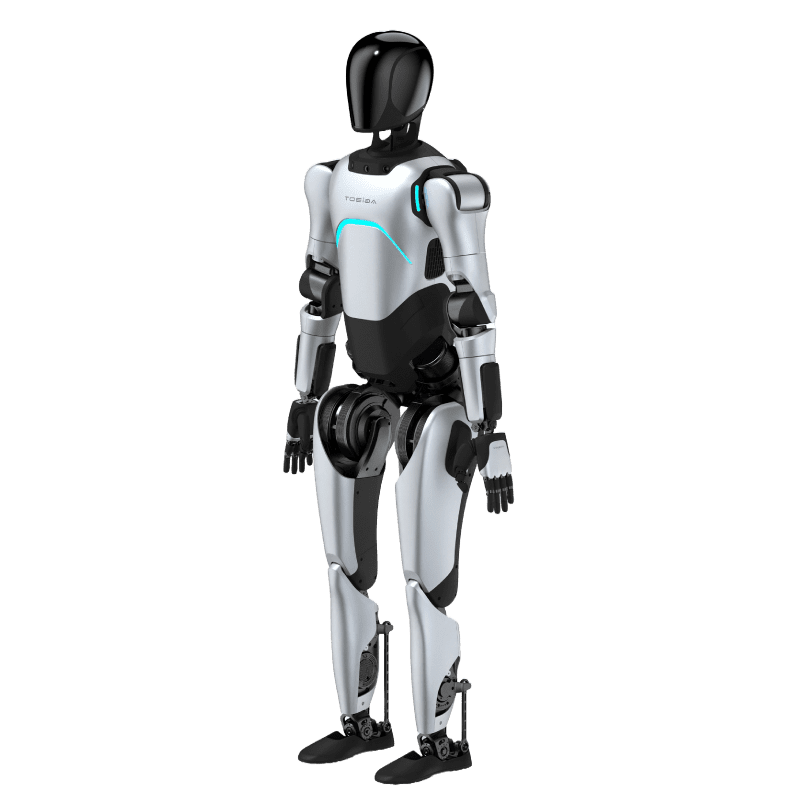
The A2 Ultra is Agibot’s flagship full-size humanoid robot designed for real commercial environments rather than lab showcases. Standing at approximately 169 cm and weighing around 69 kg, it mirrors human proportions so it can function in spaces built for people—lobbies, exhibition halls, retail floors, and corporate environments—without requiring infrastructure changes. Its industrial design balances approachability with engineering precision, which explains why it has earned international recognition for design and usability.
Mechanically, the A2 Ultra is built with roughly 40 degrees of freedom across its body, including multi-jointed arms and dexterous hands that allow for expressive gestures and controlled object interaction. Degrees of freedom simply refer to the number of independent movements a robot can make—more freedom means more natural motion but also more complexity in control. Maintaining balance while walking, turning, and interacting is computationally demanding; this is where Agibot integrates advanced motion planning and real-time feedback systems to stabilize posture and gait.
The sensing system is equally sophisticated. A combination of 3D LiDAR, depth cameras, RGB cameras, and wide-angle vision modules enables spatial awareness, obstacle avoidance, and human detection. The robot’s perception stack allows it to navigate dynamic indoor environments while recognizing faces and responding contextually. It also includes microphones and speakers for voice interaction, along with a facial display that supports expressive communication and branding customization.
Software is where the A2 Ultra becomes more than hardware. It supports autonomous navigation, AI-driven interaction, cloud connectivity, and over-the-air updates for continuous improvement. Hot-swappable batteries and fast charging allow extended operational cycles, making it suitable for high-traffic environments such as exhibitions, receptions, guided tours, and brand activations. The system is designed for scalable deployment, signaling Agibot’s intention to move humanoid robotics from experimental novelty to structured commercial adoption.
The larger strategic play is clear: build a humanoid that can operate in human ecosystems without reengineering the world around it. Whether this approach becomes economically dominant will depend on reliability, cost reduction, and real productivity gains—but the A2 Ultra represents a serious step toward industrializing humanoid robotics rather than merely demonstrating it.